Putting the Paper to Bed

A tightly cropped photo of the front page of The Atlanta Journal-Constitution, focused on its slogan, "Credible. Compelling. Complete."

The Atlanta Journal-Constitution announced on Thursday that it would be ending its print edition — which has been published in some form since 1868 — at the end of the year.

I grew up outside Atlanta, at a time when it was nominally still a two-newspaper town: The Constitution was delivered in the morning, and The Journal arrived in the afternoons. My parents subscribed to The Journal, whose opinion page leaned more conservative and had one of the great newspaper slogans: Covers Dixie Like the Dew.

My grandfather was also a longtime advertising executive at the AJC. Although I started my own career in newspapers long after he retired, the business was a bond between us until he died. (He routinely mailed me clippings from the AJC that had caught his attention over breakfast, often from the left-leaning columnists he vehemently disagreed with.)

Despite that background, I didn’t immediately gravitate toward journalism in college. But I got there eventually and have — happily, and very, very luckily — been there ever since. I started in my first “professional” newsroom 30 years ago this summer, and my favorite gallows-humor description of that time comes from a 2017 piece in McSweeney’s:

Michelle Jones remembers graduating journalism school twenty-five years ago and being warned that the industry was declining because advertisers were pulling out, salaries were dropping and the internet would ruin everything. And that’s pretty much what happened.

I’ve been extremely fortunate to hold onto a job in a field that has been radically transformed since the time I graduated from journalism school, much less from when my grandfather started working for the AJC almost 90 years ago. I’ve had literally hundreds of friends and colleagues lose their jobs over the years. The AJC news followed widespread buyouts at one of the other papers near and dear to my heart, The Washington Post, that one media critic called “the most spectacular departure of journalistic talent from a newspaper” in decades.

Despite all this bad news, I was heartened by, and agree with, a quote from the AJC’s publisher about the decision to end its print edition: “Unless news organizations have the courage to disrupt themselves faster than the marketplace is disrupting the industry, really important institutions that have existed for generations will cease to exist.” He added, “I love print, but I love journalism more.

At Least We Had Fun

“If you spend a lifetime in journalism, you may have some stories that matter more, you may do work that is of greater importance, and you may serve some greater societal purpose. But you will never have as much fun as when you and the other sleep-deprived and beerstained wonders around you published your own damn newspaper.”

— David Simon, The Diamondback, March 10, 2020

David Simon feels about his experiences at his college newspaper the way I do about mine.

Daring to Be Dull

“Straight as an arrow, exasperatingly thorough, extremely earnest, smart, plain, pragmatic, wonkish. He was a stickler, a self-described curmudgeon.”

David Butler, an editor for Stars and Stripes, was beaten to death almost 17 years ago in Arlington, Va., on his way home after a night shift.

I was in D.C. at the time, and although I never met him, this remembrance has stuck with me, partly because of the horrific nature of the crime, which appears to remain unsolved. But in him I also saw — perhaps with some self-flattery and a touch of embarrassment — myself.

His work mirrored my own, hanging around “in case you have to tear up the front page for a nuclear explosion or the death of a princess.”

(Like him, I was in the newsroom on my 30th birthday, which was an election night. Like him, I was surrounded by pizza boxes. Unlike him, I was not in the company of a stripper.)

I was also well familiar with “those strange small hours, our 5 p.m., our quitting time, the world’s middle of the night” and could easily envision the circumstances in which he was killed.

I’ve recently been thinking about David because he sounded like most of the journalists I’ve worked with over a 22-year career in newspapers: dedicated, careful but human, and honestly trying to provide a fair and accurate account of the facts in an often messy world.

“He was, in short, everything you want in the guy who edits your newspaper.”

“The financial needs of news companies mean that they cannot afford to advance ideas which wouldn’t very quickly be able to find favour with enormous numbers of people. An artist can make a decent living selling work to fifty clients; an author can get by with 50,000 readers, but a news organization cannot pay its bills without a following larger than the population of a good-sized metropolis. What levels of agreement, what suppression of idiosyncrasy and useful weirdness, will be required to render material sufficiently palatable to so many  . . . Wisdom, intelligence and subtlety of opinion tend not to be sprinkled through the population in handy blocks of 20 million people.”

— Alain de Botton, The News: A User’s Manual


— 30 —

One of the craziest things I did in college was to take four classes from Conrad Fink in the course of two quarters. I was partway through my junior year at the University of Georgia before I applied to the Grady College of Journalism. At that point, I also hadn’t worked at the student newspaper, the Red & Black. As such, I was in a rush if I was to graduate on time. I don’t remember having much of an impression of Fink* before I landed in one of his classes, even though his liberal use of a red editing pen was well-known in the halls of Grady. But in less than six months, he became the greatest teacher I ever had.

(* Fink always referred to students by their last names, and most of his students referred to him only by his. I didn’t learn the first names of some of my closest friends in college until weeks after meeting them in one of Fink’s classes.)

By the time he joined the university in 1983, Fink had already had a career any journalist would envy: an Associated Press correspondent in south Asia during the 1960s who went on to become a vice president at the news service. He later shared his experience with, literally, thousands of UGA students. I was one of them.

He began each class by leading a critique of that morning’s papers, starting with the Red & Black. Fink always said the most important thing the “untutored and unwashed” could do to further their journalistic careers while at school was, with the exception of taking his classes, to work at the R&B, and I think he always had a soft spot for those of us who did, even if late nights spent in the newsroom meant our grades weren’t among his students’ best. As embarrassing as it sometimes was to have him dissect one of your stories in front of the class — “Stanford, your own mother wouldn’t read that lede!” — to this day I remember the compliments he paid some of mine.

(Scene: Fink walks in and drops a two-foot length of cable the size of your wrist on the table at the front of the class. He then barks about how, in his day, the stories he sent from the rice paddies of Vietnam had to travel, one painstaking character at a time, over this sort of cable to the AP office in New York. It took forever. But now, he said, waggling his legendary eyebrows, the same story can be sent over a fiber optic cable far smaller than this — holding up his pinkie — in less than the time it’s taken me to tell you this story.)

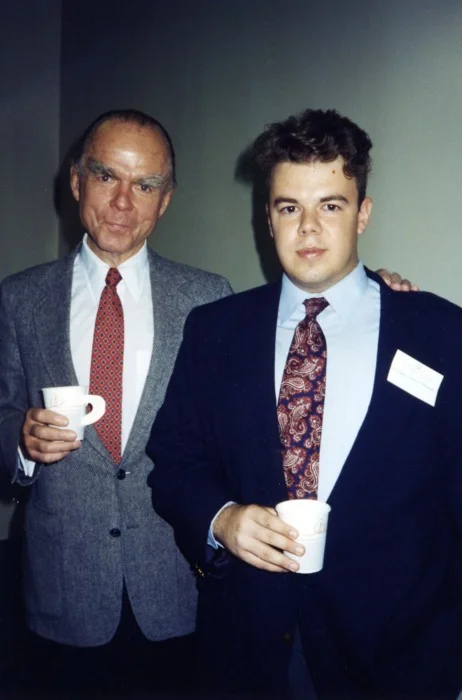
I graduated from the university’s journalism school in December of 1994. Not being the traditional June commencement, there wasn’t a lot of pomp or circumstance or caps or gowns. Fink was good enough to pose for a photo, despite my questionable taste in neckwear:

I went on to work at The Augusta Chronicle and The Orlando Sentinel. Unlike some “Finksters,” I didn’t keep in close touch with him after leaving school. I did call him once for advice when I was in Florida, after an editor in Augusta e-mailed me, wondering if I might be interested in returning. “Never go back,” Fink said. “Always move forward.”

And so I did, eventually landing at The Washington Post. A couple of years ago, he left a message on my Facebook wall in the terse syntax of someone who once had to make every word count: “stanford, why i never hear from you? others check in. what now doing at post? fink”. We exchanged e-mails, and he then invited me to return to the j-school and spend nearly a week talking to classes about my newsroom experience. To my initial fretting about keeping the students entertained, he responded simply, “Keep your sentences brief and interject what I remember to be your feeble sense of humor — and we’ll have a ball.” We did.

Here we are again last February, after my “keynote address,” a little more than 16 years after the photo above was taken:

Fink died on Saturday after a long battle with cancer. Appropriately, Russ Bynum — a college friend, Finkster and current AP reporter in Savannah — wrote his obituaryFink’s Facebook wall is awash in tributes, many far more eloquent than this one, and a Google map tracking his influence on the nation’s newsrooms quickly popped up.

Part of what made Fink a great teacher was that he was as generous with his time as he was often measured in his praise. I’ve had many professors and managers who said they had open door policies; Fink really meant it (“The door is always open, the traps always set”).  

The internet has forever altered the news business in the time since I left Fink’s classroom, even more than the fiber optics that replaced the cable he once brought to class. Even if Fink didn’t fully anticipate the coming changes — and no one did — his lessons stand. In a video that’s been widely circulated in the days since he died, Fink discusses journalism in the age of Twitter (of which he was mildly dismissive but still used):

“Journalism is why, what, where, what does it all mean, what can we expect. That’s journalism.” — Conrad Fink